
Some places are designed to transport us to worlds far from our own. At a zoo, visitors expect to be immersed in experiences that evoke distant worlds, from the warmth of an African savanna to the stark beauty of an Antarctic tundra. Similarly, theme parks like Universal or Disney invite guests to step into the living stories and of their favorite films, books or dream destinations.
While the finished space ultimately takes center stage, the true magic unfolds behind the scenes.
For the fabricators and creators behind those iconic spaces that thousands of visitors explore every day, the challenge is blending all the structural and safety requirements so seamlessly into the themed environment so skillfully that guests only see the magic behind the experience, not the mechanics.
“I don’t think people realize just how artistic and creative this work really is,” says Matt Brown, Nassal’s vice president of operations. “Our team can take something as basic as concrete and turn it into a tree, a volcano or whatever the project calls for. It’s amazing what they’re able to create. Most people wouldn’t believe what goes into making sure these things look real and last forever.”
Collaboration and early involvement are at the heart of Nassal’s most successful projects.Through a portfolio of innovative techniques, Nassal transforms the complex infrastructure behind the curtain into unforgettable immersive experiences.
Here's a look at invisible engineering in action on some of Nassal’s most iconic projects.
Wizarding World of Harry Potter™ at Universal Orlando Resort

No two projects are ever the same, even when they appear to be. Take, for example, the Wizarding World of Harry Potter™ installations at Universal Orlando Resort, Universal Studios Japan and Universal Studios Hollywood. While each shares a consistent visual identity, the engineering and construction strategies had to be tailored to vastly different environmental conditions, building codes and guest expectations.
“Even though the Wizarding World of Harry Potter™ projects may look similar on the surface, each one was uniquely complex,” says Brown. “Just looking at code requirements, for example, at Universal Orlando, we had to design and fabricate for hurricane resistance. In Hollywood, earthquake resilience was the priority, while in Japan, we had to account for both earthquakes and tsunamis. What ties them all together is that they all had to feel like they came from the same iconic world that so many people love. Pulling that off on projects that are actually very different is no easy feat.”
To meet these challenges, Nassal worked with the integrated project team early to adapt its fabrication strategy for each location. In Orlando, the team was able to hand-carve much of the projecton-site, allowing for direct control over art direction. However, for Japan and Hollywood, the company shifted to a prefabrication model to maintain a high level of finish while meeting aggressive timelines. This resulted in more than 42,000 individual parts for each park, all fabricated and scenically completed in Orlando before being shipped overseas for installation. Local contractors handled the on-site build, with Nassal maintaining a close supervisory role to ensure consistency and quality across all locations.
Blending Natural Elements with Themed Artificial Trees

Customization and creativity are essential to invisible engineering even at the smallest scale. This is especially true when the goal is to replicate something that nature has already perfected — a tree or rock formations — and make it look so real, it blends into the surrounding environment for humans and animals alike.
At the Jacksonville Zoo’s African Forest exhibit, Nassal fabricated and installed a 47-foot-tall artificial kapok tree with a 45-foot canopy shade structure, along with over 6,000 square feet of themed rockwork and mud bank veneer. The level of customization for projects like this demands not only technical expertise but also a deep well of creativity, especially when clients present bold ideas that require entirely new solutions.
“Our clients come to us with a concept sketch and ask, ‘Can you build this?’ And our job is to figure out how to make it real,” says Ken Torrence, a Nassal senior superintendent and art director. “Every project is different, which means we can’t rely on a one-size-fits-all approach. Instead, we’re constantly reinventing our process to meet the unique demands of each build.”
To achieve hyper-realistic finishes, Nassal often begins by capturing textures directly from nature. On a private residential project in Hawaii, the team was assigned the tricky job of concealing utility infrastructure within the jungle setting. The solution involved fabricating artificial trees that mimicked the surrounding sea grape trees. Using silicone molds taken from real bark, they stamped sculpt-able epoxy over fiberglass structures to replicate authentic textures.
Once painted and detailed, the fabricated trees became indistinguishable from the real ones, allowing the infrastructure to visually disappear into the landscape. The level of detail and realism in these projects, where even the most complex infrastructure disappears into environments that feel entirely natural, defines Nassal’s invisible engineering.
Volcano Bay: Complex Rockwork Construction for Theme Parks
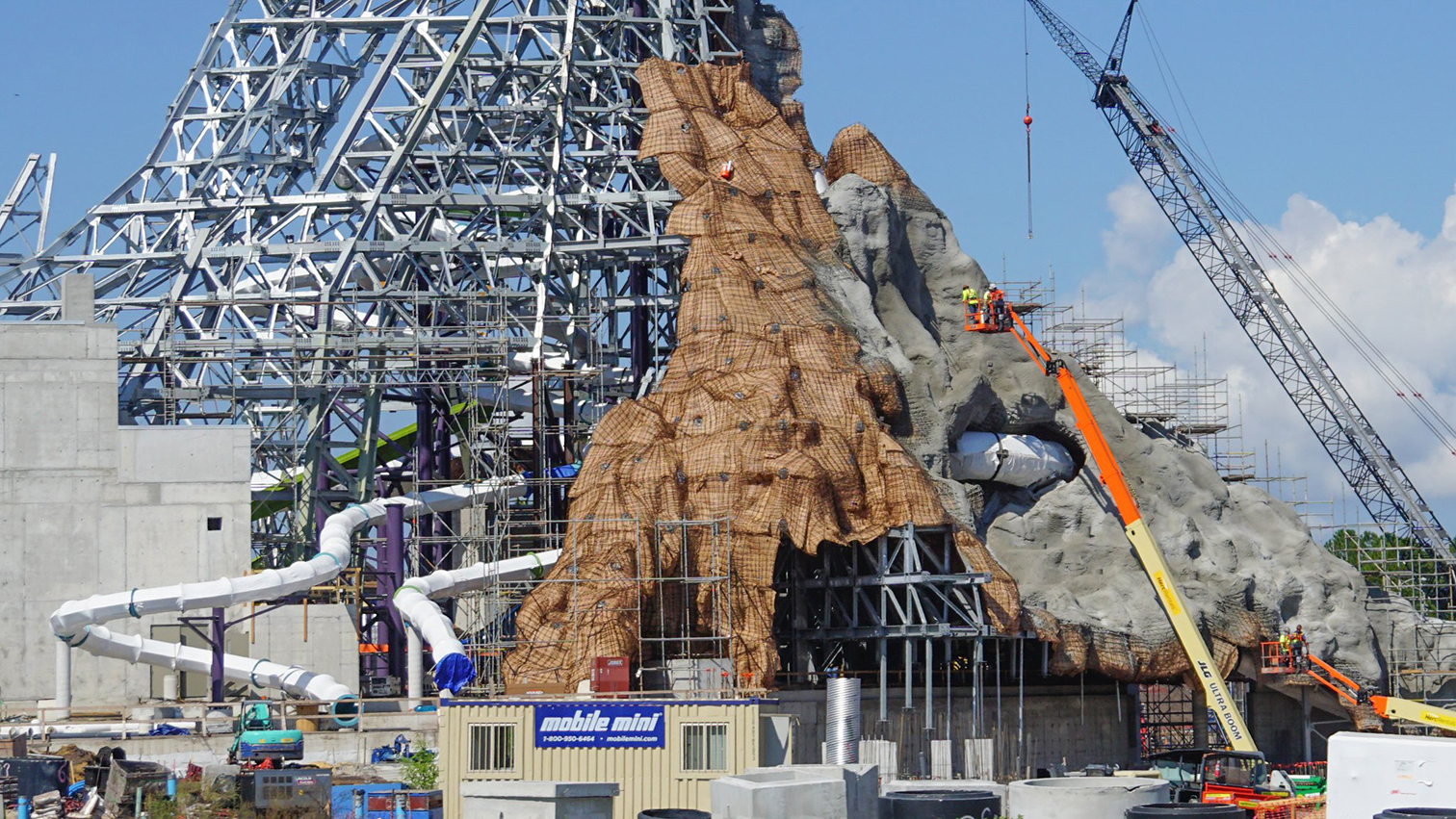
One of Nassal’s most seismic feats? Bringing Krakatau to life, the towering 200-foot artificial rockwork volcano at Universal Orlando’s Volcano Bay. Known for its expertise in themed artificial rock formations, Nassal’s rockwork team delivered over 300,000 square feet of immersive scenic fabrication for this project. To achieve the vision, the team began with digital sculpting, developing 3D models of the rockwork to allow for early coordination, clash detection and seamless integration.
Once the digital designs were approved, the team developed another model to coordinate the internal structural framework. This model was divided into thousands of custom-shaped “chips,” which are prefabricated panels designed to fit together like a puzzle. These chips formed the outer shell of the volcano, allowing for precise construction and efficient installation.
In the field, the chips were mounted onto a steel structure, followed by concrete application and scenic finishing. Carving, texturing and painting brought the volcano to life, blending artistry with engineering.
“Building the volcano at Volcano Bay was like assembling a massive, sculpted puzzle,” says Brown. “It was a complex process that required everyone to be on the same page, but it’s the kind of project that allows us to turn engineering into art.”
Beyond artistic fabrication, safety and durability are foundational to Nassal’s approach to invisible engineering. Every project is designed with guest interaction in mind — anticipating behaviors like climbing or touching while ensuring themed environments stay safe and accessible. In high-contact spaces such as zoos and aquariums, Nassal uses non-toxic, eco-friendly materials to protect both people and animals. In some cases, this has meant developing entirely new products and fabrication methods to meet strict safety standards. Long-term maintenance is also carefully considered, with removable panels and discreet access points built into scenic elements to allow for repairs without compromising the visual integrity of the environment.
Invisible engineering is more than a construction technique; it’s a philosophy that blends creativity, craftsmanship and technical skill to create environments that feel authentic and immersive. At Nassal, each project brings together artists and engineers, blending creativity with technical expertise to bring themed spaces to life.
“At our core, we’re an art company, a team of artists and craftsmen,” says Torrence. “From millworkers and painters to rock sculptors, our people bring imaginative concepts to life, whether it’s a show-stopping centerpiece or a structure so seamlessly integrated into its surroundings that guests never even realize it’s there. And that’s exactly the point.”
Through invisible engineering, Nassal shapes experiences that captivate and endure, without ever revealing the complexity behind the curtain.

.svg)